
Welcome, friends of Batesville High School and Junior High School cross country. This is the place for comprehensive unofficial information about Pioneer runners. Official results may be found by date and race name at ar.milesplit.com/results.


Yearly results list season-to-date times for all runners, with matching times from past years for returning runners. Junior high races range from 1.55 to 2 miles, and may vary from meet to meet and sometimes from year to year at the same meet. The tables generally make note of that.
STARTING LINE
This is your introduction to terminology, distances, scoring, and procedures.
FIRST TERMS
CROSS COUNTRY is racing over mixed terrain, mostly grass, dirt, and woodland trail over or around natural obstacles. A collection of races scored by varied categories is called a MEET. Meets are often labeled as OPEN or INVITATIONAL, which strictly speaking differ as “invite yourself” or “be invited by the host,” but the typical high school meets are open entry. A DUAL MEET is a head-to-head contest of two teams. Some larger events may separate results into an overall score as well as breaking out multiple dual meets where certain teams are scored only against each other with all other athlete times excluded. High school meets usually include four races: junior high girls, junior high boys, senior high girls, and senior high boys.
Cross country meets are free admission except for state championships and the occasional limited-entry park or similar location.
DISTANCES AND SCORING
Race distances are in meters or miles, with 5,000 meters (5K, 3.1 miles) standard for senior high. Junior high races are mostly half that, 2.5K (1.55 miles), though slightly shorter 1.5 miles or longer 2 miles are not unusual. College races vary with 5K, 8K, and 10K most common.
Team SCORING is by cumulative points, lowest score wins. POINTS are awarded by finishing place, and the team score is the total for the squad’s first five finishers. Most races also allow two more runners to be tallied as DISPLACERS, with their places counted but not added to their own team’s score. A team’s fifth finisher might be 25th among the scorers, then their sixth finisher in say 30th place would not add to the team total but the next runner following would still count 31 points toward another team. If a team has fewer than five runners, their athletes may receive individual awards for their overall place, but their finishes will be dropped and the places reset accordingly for settling team trophies. The team tiebreaker is best sixth runner finish if teams have displacers, best fourth runner finish if they do not.
RUNNERS ALL
Cross country is an individual endeavor but a tremendous team sport. “Low score wins” means that the most important runners on any team are the fourth through seventh fastest. Any one of those having their best race on a given day will be the hero with a low-number finish. The fastest runners will always be in the low numbers, so a good day might be the difference between 3 and 8 points. A slower runner who usually finishes 50th might have a great day and finish 30th for a 20-point swing! Yet, every single point counts and a mid-pack runner who catches a rival at the line adds points to the rival score. So the sixth and seventh displacers noted above can make a difference against the rival’s fourth and fifth. A team is only as good as it is deep, and all can be the hero any day.
A team has no benchwarmers: All who practice can race. Five score, usually two displace, but others also race and have recorded results. Some larger events and championships do limit entries to seven or nine per team, in which case the team’s fastest go, with occasional exceptions in the back spots to reward seniors or special contributors even though they may not be as fast.
OUT AND BACK
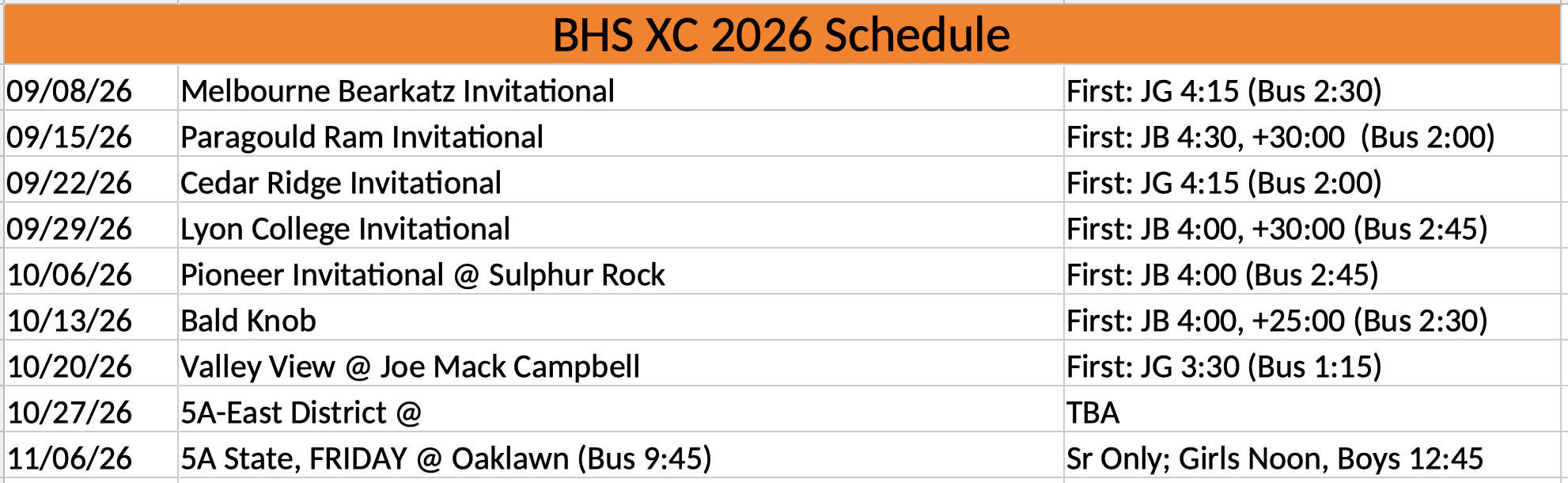
TRAVEL RULES: Athletes ride the team bus to meets; departure is at a fixed time: NO WAITING FOR LATECOMERS!
Athletes should behave as honored guests, respectful of hosts, officials, and venue in language, deportment, and maintenance.
Parents attending may sign out their children and take them home after their events. But (particularly under COVID restrictions) ONLY PARENTS are allowed to take THEIR OWN CHILDREN home. Even under lesser restrictions, any other arrangement should be made formally in advance with coach, athletic department, administration.
Girls and boys are separated in sections.
Common courtesy to the bus driver on a night drive wrapping up a long day: Phone lights, gaming screens and noise should be avoided.
Those riding the bus home will call parents as the team is 15-20 minutes out from campus so that parents reach the parking lot in timely fashion to pick up.